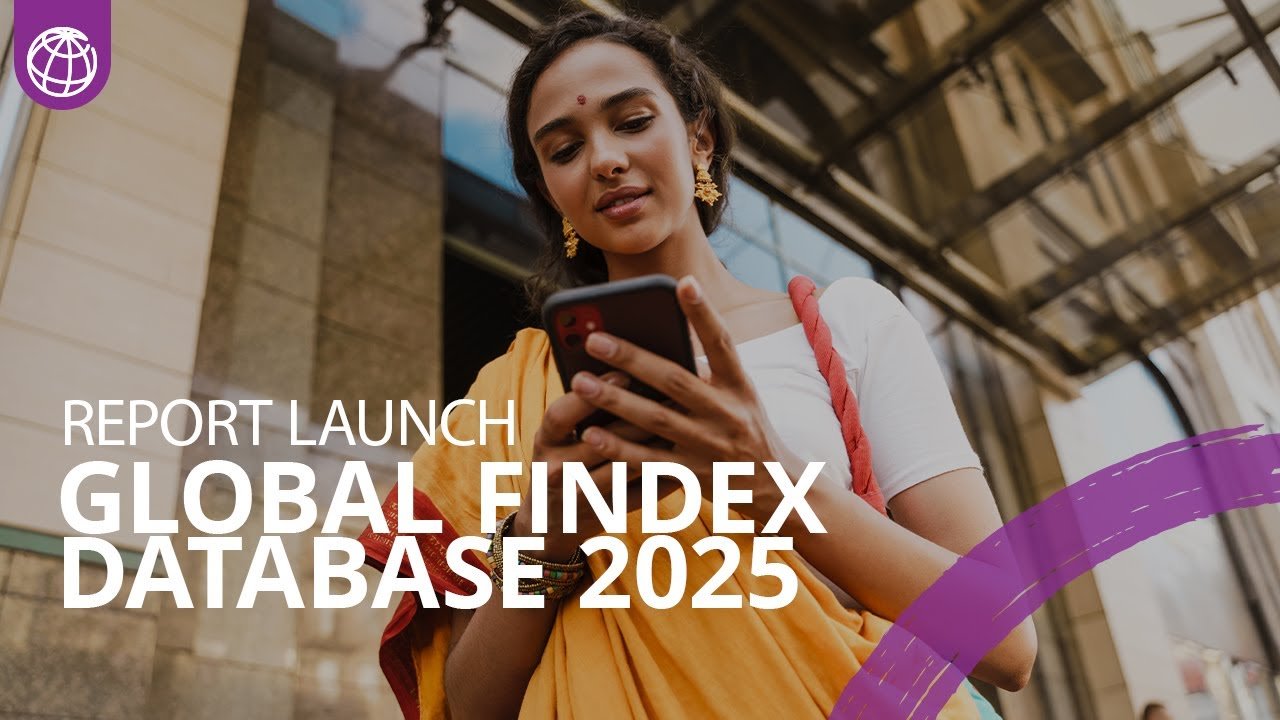
Nearly 80% of adults worldwide now have a financial account, up from 50% in 2011, yet 1.3 billion adults remain unbanked, according to the World Bank’s Global Findex 2025. In the Middle East and North Africa, account ownership reached 53%, the lowest of the regions the World Bank reports, up from 45% in 2021.
Findex measures financial inclusion from the user’s side, by asking adults directly how they save, borrow and pay. Here are the numbers that matter for inclusive finance practitioners and investors.
About the report
| Publisher | World Bank |
| Released | 16 July 2025 |
| Title | Global Findex 2025: Connectivity and Financial Inclusion in the Digital Economy |
| Data covered | Nationally representative surveys of adults, with 2024 data compared to 2021 and earlier rounds back to 2011 |
| Latest edition? | Yes, as of October 2026. Findex is published every three to four years |
Because Findex is released only every few years, the 2025 edition will remain the reference for most funding proposals and policy papers until the next round. That makes it worth knowing well.
Key findings
- Nearly 80% of adults worldwide have a financial account, up from 50% in 2011, while 1.3 billion adults still lack one, according to the World Bank.
- Account ownership reached 58% in Sub-Saharan Africa, up from 49% in 2021, and 53% in the Middle East and North Africa, up from 45%, the Global Findex 2025 finds.
- In low- and middle-income economies, 40% of adults saved in a financial account in 2024, up 16 percentage points since 2021. Formal saving rose 12 points to 35% in Sub-Saharan Africa and to 17% from 11% in MENA, according to the World Bank.
- Women’s account ownership in low- and middle-income economies reached 73% in 2024, up from 37% in 2011. Globally, 77% of women and 81% of men have an account, a 4-point gap, the Global Findex 2025 reports.
- 86% of adults own a mobile phone and 68% own a smartphone, and about 900 million adults without an account own a mobile phone, 530 million of them a smartphone, according to the World Bank.
- 42% of adults in low- and middle-income economies made a digital merchant payment in store or online in 2024, up from 35% in 2021, the Global Findex 2025 finds.
- Only about half of the roughly 4 billion mobile phone owners in low- and middle-income economies protect their phone with a password, the World Bank reports.
Account ownership by region in the 2025 Findex, as reported by the World Bank:
| Region | Adults with an account |
|---|---|
| East Asia and Pacific | 83% |
| South Asia | Nearly 80% |
| Latin America and the Caribbean | About 70% |
| Sub-Saharan Africa | 58% (49% in 2021) |
| Middle East and North Africa | 53% (45% in 2021) |
What Global Findex 2025 means for inclusive finance in MENA and Africa
The access story is close to complete in some regions and far from it in others. The next phase is about use, savings and safety, and that is where impact organizations can add most.
- MENA is the access frontier. At 53%, the region trails every other one in the World Bank’s breakdown. Fintechs, microfinance institutions and NGOs in North Africa and the Levant still have a basic access problem to solve.
- The phone is the channel. 900 million unbanked adults already own a mobile phone. Products designed for basic phones and agent networks reach them faster than branch expansion.
- Savings beat accounts as an outcome. The 16-point jump in formal saving is a more meaningful impact metric than account openings. Investors in inclusive finance should ask portfolio companies for active use and savings balances, not sign-up counts.
- Digital safety is an impact issue. If half of phone owners use no password, fraud risk grows with every new user. Consumer protection and financial literacy belong in program budgets.
See also our guide on promoting financial inclusion.
Download the full report
The World Bank publishes the Global Findex 2025 report, country data and microdata free of charge. The report is authored by the World Bank, not by Impact DOTS.
FAQ
Nearly 80% of adults worldwide, according to the World Bank’s Global Findex 2025, up from 50% in 2011.
About 1.3 billion adults lack an account.
53%, up from 45% in 2021, the lowest regional rate in the World Bank’s breakdown.
The World Bank released it on 16 July 2025, using survey data from 2024.
No. As of October 2026, Global Findex 2025 is the latest edition. The survey runs every three to four years.
Sources
- World Bank: Mobile-phone technology powers saving surge in developing economies, press release
- World Bank: The Global Findex Database