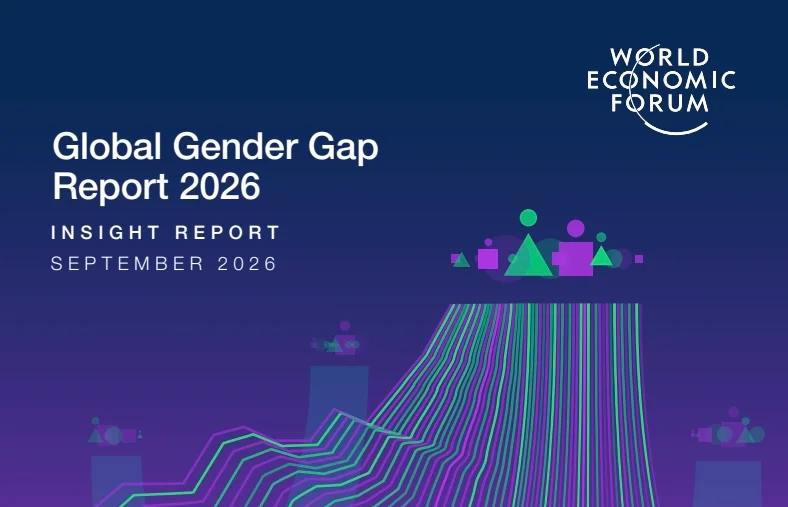
The world has closed 69.2% of its gender gap, up from 68.8% in 2025, and full parity is 120 years away at the current pace, according to the World Economic Forum’s Global Gender Gap Report 2026. The Middle East and North Africa closes 62.5% of its gap, the lowest score of any region.
Published on 16 September 2026, the report marks 20 years since the index began in 2006. Here is what the data says, with a focus on MENA and Sub-Saharan Africa.
About the report
| Publisher | World Economic Forum |
| Published | 16 September 2026 |
| Coverage | 145 economies, with a constant sample of 97 economies tracked since 2006 |
| Method | Four subindexes: Economic Participation and Opportunity, Educational Attainment, Health and Survival, Political Empowerment |
| Latest edition? | Yes, as of October 2026 |
Scores show the share of the gap between women and men that has been closed, where 100% means parity. The report ranks economies on outcomes, not on policies, so a country can pass reforms and still score low until those reforms change who works, earns and governs.
Key findings
- The global gender gap is 69.2% closed in 2026, and at the current rate full parity will take 120 years, the Global Gender Gap Report 2026 estimates.
- No economy has reached full parity. Iceland ranks first at 93%, followed by Finland (87.2%), Norway (85.7%) and Namibia (84.5%), the highest-ranked economy in Sub-Saharan Africa, according to the WEF.
- Educational Attainment (96.9%) and Health and Survival (96.2%) are almost closed, while Economic Participation and Opportunity sits at 61.7% and Political Empowerment at 22.1%, the report shows.
- The Middle East and North Africa has closed 62.5% of its gap and would need 182 years to reach parity. It ranks last on Political Empowerment at 11.5%, and its labour-force participation parity fell 6.3 points, according to the Global Gender Gap Report 2026.
- Sub-Saharan Africa has closed 68.8% of its gap, with 102 years to parity and scores ranging from Namibia (84.5%) to Chad (57.8%). Its labour-force participation parity rose 18.7 points, the WEF reports.
- Women make up 41.8% of the workforce but hold 29.6% of senior leadership roles, and their share drops from 46% at entry level to 23% in the C-suite, based on LinkedIn data cited in the report.
- Women’s share of founders has stayed at about 28%, and 8.7% of female founders list AI engineering skills compared with 14.7% of male founders, the Global Gender Gap Report 2026 finds.
Regional results, ranked by share of the gap closed:
| Region | Gap closed (2026) | Years to parity |
|---|---|---|
| Europe | 75.7% | 70 |
| Northern America | 75.2% | 108 |
| Latin America and the Caribbean | 74.5% | 60 |
| Eastern Asia and the Pacific | 70.3% | 144 |
| Central Asia | 70.0% | 202 |
| Sub-Saharan Africa | 68.8% | 102 |
| Southern Asia | 64.5% | 149 |
| Middle East and North Africa | 62.5% | 182 |
What the gender gap data means for impact organizations in MENA and Africa
The pattern behind the numbers is consistent: girls and women now reach school and health services at close to parity, but the gap reopens at the point of work, pay and decision-making. That is where programs and capital can still move the score.
- MENA program designers: the region reached parity in primary and tertiary enrolment, yet labour-force participation parity fell. The bottleneck is the move from education to paid work. Employability, childcare and safe transport programs address it more directly than another scholarship scheme.
- Gender-lens investors: a founder pool stuck at about 28% women, with a gap in AI engineering skills, means deal flow will not fix itself. Pipeline building through accelerators and technical training belongs inside the investment thesis.
- Sub-Saharan Africa practitioners: labour participation parity rose sharply, but Educational Attainment is the region’s weakest dimension, with more than 10 points still open. Education remains the priority lever there.
- Researchers: use the constant sample of 97 economies for any trend over time. Rankings shift as new economies enter the index, so a rank change is weaker evidence than a score change.
For background on why these gaps persist, see our guide on gender equality in modern society.
Download the full report
The World Economic Forum publishes the full report, economy profiles and data free of charge. The report is authored by the WEF, not by Impact DOTS.
FAQ
120 years at the current rate of progress, based on the 69.2% of the global gap closed in 2026.
Iceland, with 93% of its gap closed. Finland, Norway and Namibia follow. No economy has reached full parity.
MENA has closed 62.5% of its gap, the lowest regional score, and would need 182 years to reach parity. It ranks last on Political Empowerment at 11.5%.
145 economies, with a constant sample of 97 that have been included in every edition since 2006.
Yes. The 2026 edition, published on 16 September 2026, is the most recent as of October 2026.
Sources
- World Economic Forum: Global Gender Gap Report 2026, digest
- World Economic Forum: Global Gender Gap Report 2026, benchmarking gender gaps