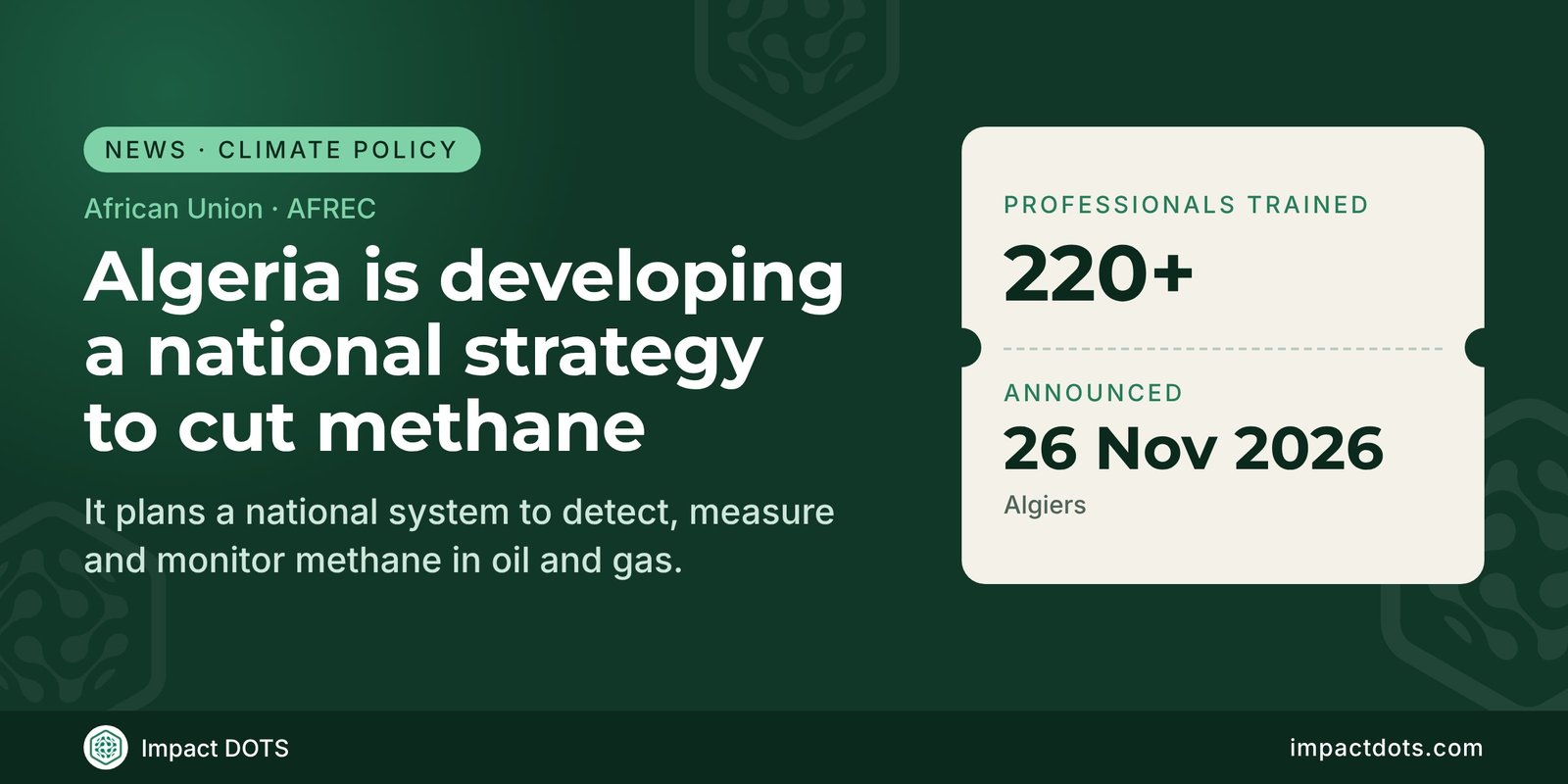
Algeria is developing a national strategy to reduce methane emissions from its oil and gas sector. The country said so at a North African roundtable held in Algiers on 25 and 26 November 2026 by the African Energy Commission (AFREC), the African Union’s specialised energy agency, which framed methane cuts as an economic opportunity.
The details
The Northern Africa Regional Roundtable on Methane Emissions Mitigation and Trade Issues for the Oil and Gas Sector ran under the theme “Turning Methane Mitigation into Economic Opportunity”. It follows earlier AFREC roundtables in Abuja, Nigeria, for Western Africa and in Luanda, Angola, for Southern Africa.
Speaking on behalf of Mohamed Arkab, Algeria’s Minister of Hydrocarbons and Mines, Director General Mostefa Ismail said the country is working towards an integrated national system to detect, measure, quantify and monitor methane emissions in the hydrocarbons sector.
AFREC Executive Director Rashid Ali Abdallah urged member states to treat methane mitigation as an economic and strategic priority. He named Algeria, Egypt, Libya, Tunisia and Mauritania as North African countries with important positions in oil and gas markets.
Two partner governments voiced support. James Downer, the British Ambassador to Algeria, said the United Kingdom supports the AFREC initiative and described methane as responsible for roughly one third of current warming. Thea Martine Ottmann, Norway’s Ambassador to Algeria, said credible measurement, reporting and verification systems help operators show results to investors and customers.
According to the African Union, AFREC’s Programme for Methane Emissions Management and Capacity Building in the African Oil and Gas Sector has trained more than 220 professionals from 24 countries since 2024.
Why it matters for impact investors and climate finance teams
A methane strategy is only as credible as the data behind it. Algeria’s stated plan starts with detection and monitoring, which is the baseline that turns an emissions pledge into something that can be checked.
For funders, the strongest signal is the weight placed on measurement, reporting and verification. Verified data is what allows methane reductions to be priced, financed and reported. If Algeria’s monitoring system takes shape, it gives investors, development lenders and technical assistance providers a clearer reference point when they assess oil and gas transition projects in North Africa.
What’s next
Confirmed: participants were expected to exchange experience, identify common challenges and explore cooperation on methane detection, measurement, monitoring and joint training. The African Union announcement gives no adoption date for Algeria’s strategy and no reduction targets.
FAQ
Has Algeria adopted its methane strategy?
No. The official announcement says Algeria is developing the strategy. It gives no adoption date and no targets.
Who organised the roundtable?
The African Energy Commission (AFREC), a specialised agency of the African Union, in Algiers on 25 and 26 November 2026.
Which countries did AFREC name as key North African producers?
Algeria, Egypt, Libya, Tunisia and Mauritania.
Source: African Union, “Algeria Develops National Strategy to Cut Methane Emissions as AFREC Convenes North African Oil and Gas Dialogue”, press release, 26 November 2026.
Announced on 26 November 2026 by the African Union.