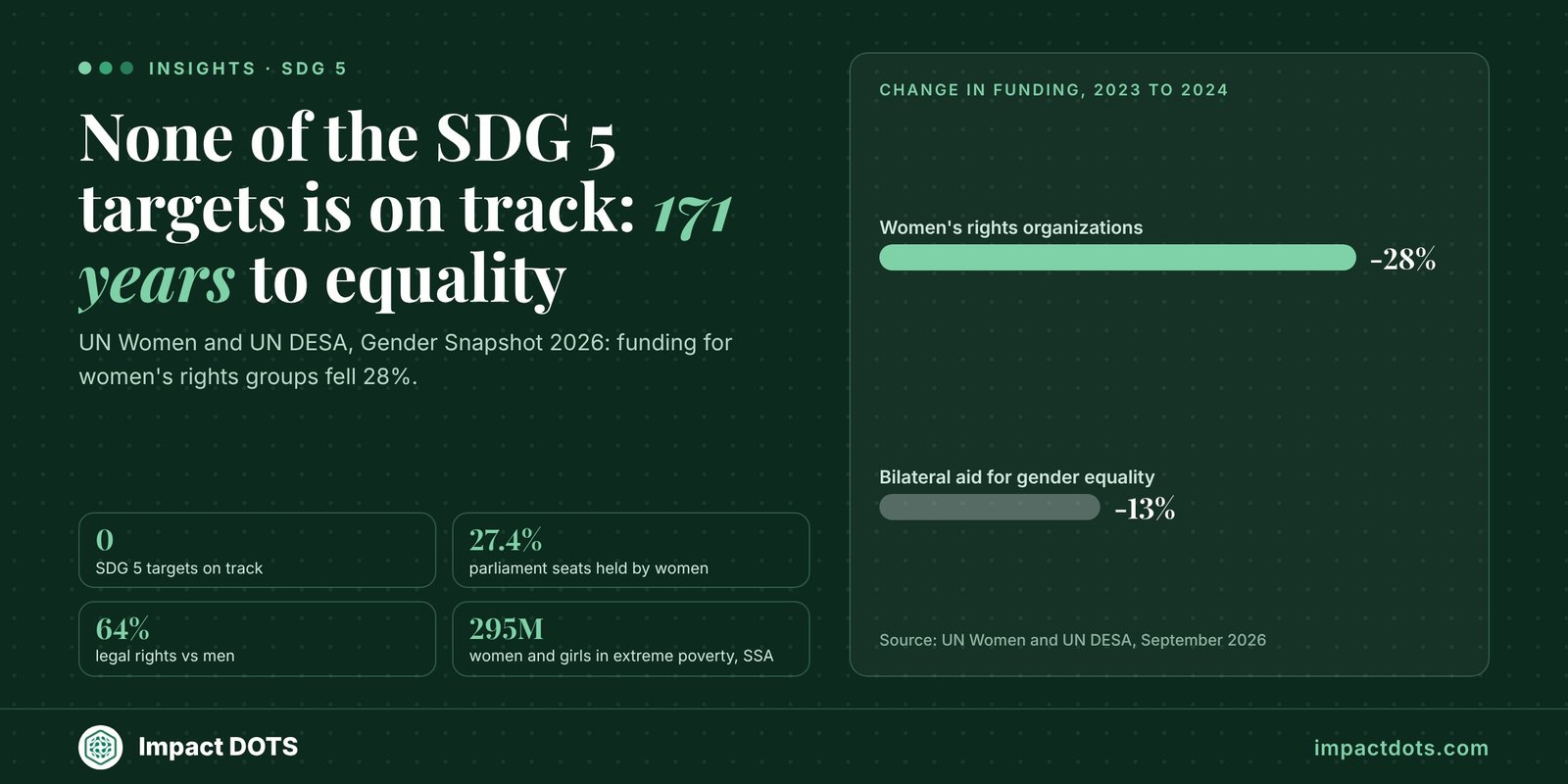
None of the targets of Sustainable Development Goal 5 on gender equality is on track to be met by 2030, and at the current rate the goal would take 171 years to achieve, according to Progress on the Sustainable Development Goals: The Gender Snapshot 2026, published by UN Women and the UN Department of Economic and Social Affairs (UN DESA) in September 2026. The report also documents a sharp fall in funding for gender equality.
For funders, NGOs and impact investors, the Gender Snapshot is the annual scorecard on SDG 5 and on how gender gaps affect progress across the other goals.
About the report
| Publisher | UN Women and UN Department of Economic and Social Affairs (UN DESA) |
| Released | September 2026 |
| Title | Progress on the Sustainable Development Goals: The Gender Snapshot 2026 |
| Data covered | Gender-related indicators across the 17 SDGs, with a focus on women’s leadership |
| Latest edition? | Yes, as of November 2026. Published every year. |
Key findings
- No SDG 5 target is on track for 2030, and achieving the goal at the current rate would take 171 years, according to UN Women and UN DESA.
- Bilateral allocable aid for gender equality fell 13% from 2023 to 2024, and funding to women’s rights organizations fell 28% over the same period.
- One in three national gender equality mechanisms reported that their institutional power eroded over the past two years, and 23% reported reduced operating budgets, the report finds.
- In 2024, 9.9% of women and 9.5% of men lived in extreme poverty. 295 million women and girls in Sub-Saharan Africa live in extreme poverty.
- Women hold 27.4% of parliamentary seats and 22.4% of cabinet posts. Women have 64% of the legal rights men have.
- Women and girls spend 2.5 times as many hours as men on unpaid care and domestic work, and 326 million women and girls live without electricity, according to the report.
Selected SDG indicators, according to the Gender Snapshot 2026:
| Indicator | Value |
|---|---|
| Years to achieve SDG 5 at current pace | 171 |
| Change in funding to women’s rights organizations, 2023 to 2024 | -28% |
| Change in bilateral aid for gender equality, 2023 to 2024 | -13% |
| Women in extreme poverty (2024) | 9.9% |
| Women’s legal rights relative to men’s | 64% |
| Women’s share of parliament seats (2026) | 27.4% |
What the report means for funders and impact organizations
- Women’s rights organizations need core funding now. A 28% drop in one year is a structural shock. Funders that can offer flexible, multi-year support will have outsized impact.
- Gender is a cross-cutting lever. The report finds that where women lead, progress follows across the SDGs, from education to environment and poverty. Gender analysis belongs in every programme, not only gender-specific ones.
- Disaggregated data is the minimum. With poverty rates differing between women and men and the widest gap among young adults, impact reports should break results down by sex and age.
- Care and energy are investable. Unpaid care and lack of electricity hold women back. Childcare, time-saving infrastructure and clean energy access are areas where investment can close gaps.
For context on the wider SDG picture, see our summaries of the UN SDG Report 2026 and the WEF Global Gender Gap Report 2026.
📥 Download the full report
UN Women publishes the full report free of charge in English, French and Spanish. The report is published by UN Women and UN DESA, not by Impact DOTS.
FAQ
No. None of its targets is on track, and at the current rate achieving SDG 5 would take 171 years, according to the Gender Snapshot 2026.
By 28% between 2023 and 2024, while bilateral aid for gender equality fell 13%.
9.9% of women and 9.5% of men lived in extreme poverty in 2024. In Sub-Saharan Africa, 295 million women and girls live in extreme poverty.
UN Women and the UN Department of Economic and Social Affairs, every year.
Sources
- UN Women: The Gender Snapshot 2026, publication page
- UN Women and UN DESA: The Gender Snapshot 2026 (PDF)