About 811 million people, or 1 in 10 worldwide, live on less than $3.00 a day in 2026, a level essentially unchanged since the pandemic, according to the World Bank’s Poverty, Prosperity, and Planet Report 2026, released on 26 October 2026. The report argues that more and better jobs are the main route back to progress.
For NGOs, funders and social enterprises working on poverty, the report sets out where the poor now live and which levers move household incomes fastest.
About the report
| Publisher | World Bank |
| Released | 26 October 2026 |
| Title | Poverty, Prosperity, and Planet Report 2026: Jobs at the Center of Poverty Eradication |
| Data covered | Household survey data from more than 130 economies, with projections to 2030 and 2050 |
| Latest edition? | Yes, as of November 2026. The report is published every two years. |
Key findings
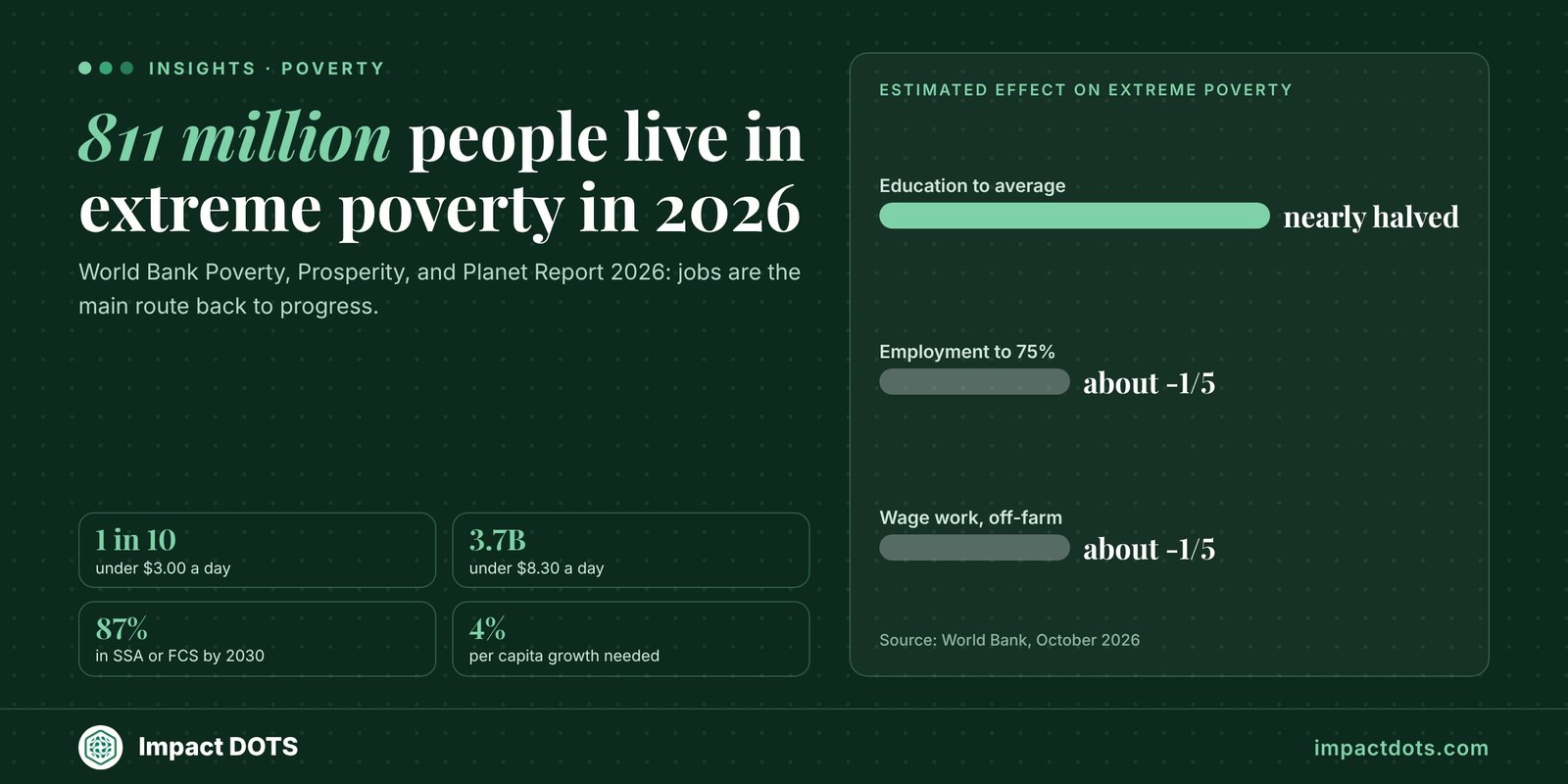
- About 811 million people live under the $3.00 a day extreme poverty line in 2026, roughly the same number as before the pandemic, according to the World Bank.
- 3.7 billion people live on less than $8.30 a day, a number that has barely moved since 1990, the report finds.
- More than half of the world’s extremely poor live in nine economies, and the World Bank projects that 87% will live in Sub-Saharan Africa or in fragile and conflict-affected settings by 2030.
- Bringing extreme poverty down to 3% by 2050 would require per capita growth of about 4% a year, roughly twice the pace of the last 25 years, according to the World Bank.
- Raising employment among working-age adults in poor households to 75% would cut extreme poverty by about one-fifth, the report estimates.
- Raising education to the average level lifts earnings by about 40% and nearly halves extreme poverty, while moving into wage work or out of agriculture cuts poverty by about one-fifth, according to the World Bank.
The levers the World Bank tested, and their estimated effect on extreme poverty:
| Lever | Estimated effect |
|---|---|
| Raise education to the average level | Earnings up about 40%, extreme poverty nearly halved |
| Raise employment in poor households to 75% | Extreme poverty down about one-fifth |
| Move into wage work or out of agriculture | Poverty down about one-fifth |
| Per capita growth of about 4% a year | Extreme poverty at 3% by 2050 |
What the report means for NGOs, funders and social enterprises
- Jobs are now the headline outcome. The World Bank frames poverty reduction through employment and earnings. Programs that report jobs created, hours worked and income change will speak the same language as the largest funders.
- Geography is narrowing. With most of the extremely poor projected to live in Sub-Saharan Africa or fragile settings by 2030, funding and partnerships are likely to follow. Organizations outside these regions should be clear about which poverty line their work addresses.
- The $8.30 line matters too. 3.7 billion people sit below it. Work in middle-income countries, including much of MENA, is better measured against this line than against extreme poverty.
- Education and women’s employment are measurable levers. The report quantifies their effect, which gives program designers a benchmark to test their own results against.
Funding conditions matter as much as the poverty data. Our summary of the 2025 fall in official development assistance shows how much less donor money is available for this work.
📥 Download the full report
The World Bank publishes the full report, with country data and methodology, free of charge. The report is published by the World Bank, not by Impact DOTS.
FAQ
About 811 million people, or 1 in 10, live on less than $3.00 a day, according to the World Bank.
3.7 billion people, a number that has barely changed since 1990.
The World Bank projects that 87% will live in Sub-Saharan Africa or in fragile and conflict-affected settings.
Reaching 3% extreme poverty by 2050 would need per capita growth of about 4% a year, roughly twice the pace of the last 25 years.
Because employment and earnings are how most poor households raise their income. Raising employment in poor households to 75% would cut extreme poverty by about one-fifth.
Sources
- World Bank: More and better jobs key to putting poverty reduction back on track, press release, 26 October 2026
- World Bank: Poverty, Prosperity, and Planet Report 2026, Open Knowledge Repository