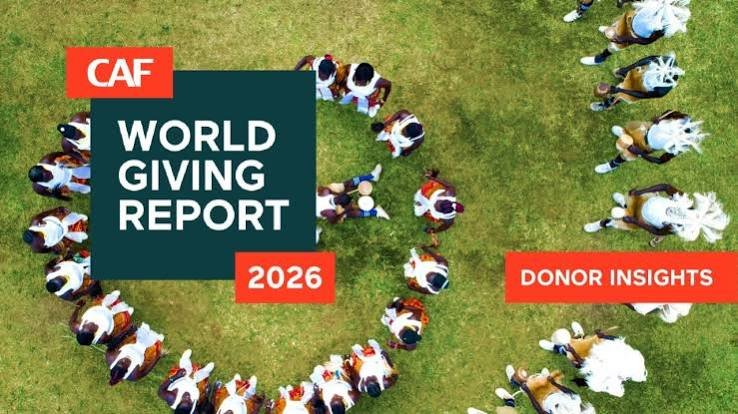
People gave about 1% of their income to good causes on average, and Africa leads every region at 1.6% of income against 0.6% in Europe, according to the Charities Aid Foundation’s World Giving Report 2026. Nigeria tops the country list at 2.8%.
Published on 3 June 2026 and based on more than 60,000 people in 105 countries, the report measures generosity as a share of income rather than in dollars. That approach changes who looks generous.
About the report
| Publisher | Charities Aid Foundation (CAF) |
| Published | 3 June 2026 |
| Sample | More than 60,000 people in 105 countries |
| Method | Survey of individual giving behaviour, including the share of income donated |
| Latest edition? | Yes, as of October 2026 |
Because the report measures giving relative to income, it captures generosity in lower-income countries that dollar-based rankings tend to miss. It also asks where money goes, which is useful for organizations deciding whether to fundraise locally or internationally.
Key findings
- 61% of people donated in the past year, down slightly from 64% in the 2024 data, according to the World Giving Report 2026.
- People gave about 1% of their income on average, and Nigeria was the most generous country at 2.8% of income, the report finds.
- The ten most generous countries by share of income are all in Africa and Asia, and people in Africa give 1.6% of income on average compared with 0.6% in Europe, according to CAF.
- People aged 25 to 44 give 1.2% of their income, twice the 0.6% given by people over 55, the World Giving Report 2026 shows.
- Religious causes are supported by 31% of people, and children and young people and poverty relief by 29% each, according to the report.
- Donors favour local (56%) and national (55%) charities over organizations working across many countries (22%), the World Giving Report 2026 finds.
- In countries where more than 80% of people feel a strong sense of community belonging, giving is nearly three times higher than where belonging is low, according to CAF.
What the World Giving Report 2026 means for fundraising in Africa and MENA
The report challenges a habit in the impact sector: treating Africa mainly as a recipient of foreign philanthropy. By share of income, people in Africa give more than people in Europe.
- Local fundraising deserves a real budget. NGOs and social enterprises in Africa that rely only on foreign grants are ignoring the most generous regional donor base in the survey. Community fundraising, diaspora campaigns and mobile giving are worth testing.
- Faith-based giving is a mainstream channel. With religious causes supported by 31% of people, organizations in MENA and Muslim-majority Africa can work with established practices such as zakat and sadaqah where their mission fits, with transparent reporting on how funds are used.
- Younger donors give a larger share. The 25 to 44 group gives twice the share of income of over-55s. Digital channels and clear impact evidence matter to this group.
- International NGOs should partner locally. Donors prefer local and national charities by a wide margin. Co-branded campaigns with local partners can reach donors who would not give to a global brand.
Pair this with our summary of the GHA Report 2026, which shows private humanitarian funding falling, to see why diversified, local fundraising matters now.
Download the full report
The Charities Aid Foundation publishes the World Giving Report 2026 and its country data on a dedicated site. The report is authored by CAF, not by Impact DOTS.
FAQ
The Charities Aid Foundation, a UK-based charity. The 2026 edition was published on 3 June 2026.
Nigeria, where people give an average of 2.8% of their income.
About 1% of their income, according to the World Giving Report 2026.
Africa, at 1.6% of income on average, compared with 0.6% in Europe.
More than 60,000 people across 105 countries.