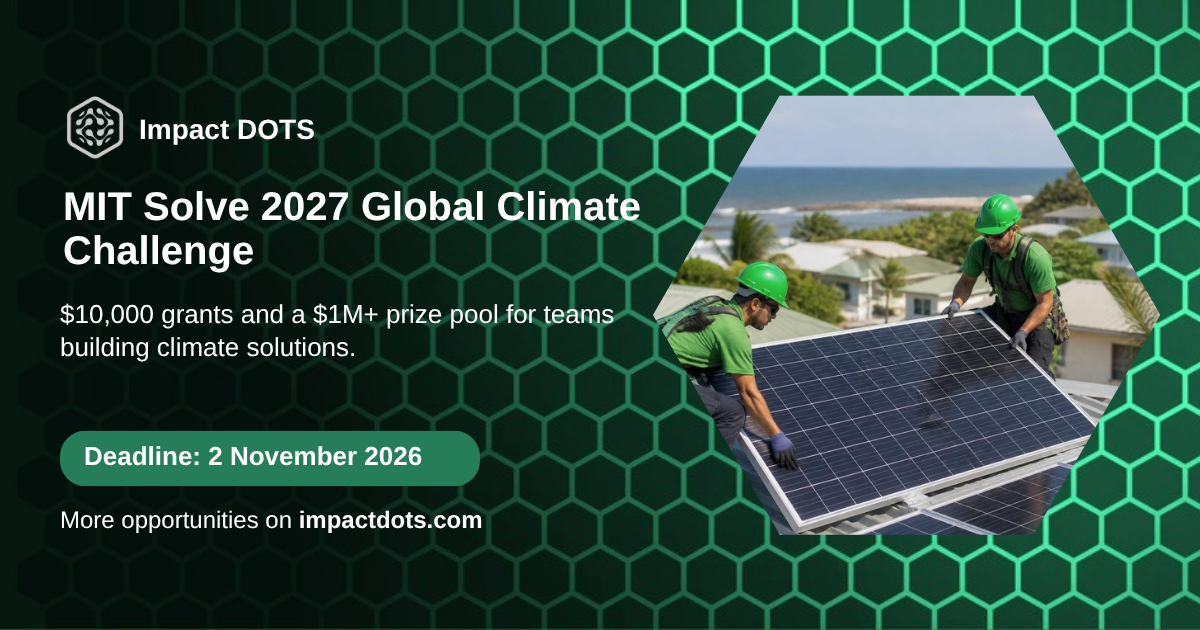
MIT Solve is accepting applications to its 2027 Global Climate Challenge until 2 November 2026 at 12:00 pm EST. Every team selected as a Solver receives a $10,000 grant, and the challenge page lists a prize pool of more than $1 million. Nonprofits, for-profits and individuals can apply, with solutions at any stage from concept to scale. The question to settle before you start is what evidence you can show for your solution’s impact and feasibility.
At a glance
| Deadline | 2 November 2026, 12:00 pm EST (applications opened 22 September 2026) |
| Who can apply | Nonprofits, for-profit organizations and individuals; solutions at concept, prototype, pilot, growth or scale stage |
| Funding | $10,000 grant for every selected Solver team, plus access to a $1M+ prize pool and specialized prizes |
| Program | Nine-month support program with workshops, coaching and in-kind resources |
| Selection | Finalists announced in February, virtual live pitch and Q&A in February |
| Cost to apply | No application fee mentioned on the official page |
| Official page | MIT Solve 2027 Global Climate Challenge |
Who can apply
MIT Solve states that it encourages people of all backgrounds to apply. Technology is defined broadly and includes digital tools, traditional and ancestral knowledge, and nature-based solutions. Previously selected Solvers may reapply only with a new solution. The page states no geographic restriction, although some prizes are limited to US-based teams.
Your solution must address one of four priority areas: low-carbon, climate-resilient cities (construction, retrofitting, mobility and circular materials); climate hazard protection (infrastructure, water systems, cooling and risk management for heat, floods, drought and wildfire); climate-resilient food systems; and ocean and coastal sustainability (fisheries, coastal protection and renewable energy).
What you get
All Solvers receive a $10,000 grant. The page says the average funding after selection is $40,000, and it describes a prize pool above $1 million available at selection and through the program year. Specialized prizes listed on the page include the AI for Humanity Prize (up to $150,000), the Prince Albert II Ocean Prize (up to $100,000), the Schmidt Marine Wavemaker’s Prize (up to $100,000) and the Seeding the Future Food Systems Prize ($150,000). Each carries its own conditions, so read them before you assume you qualify.
The nine-month program takes about 25 hours of your time plus 8 days of required in-person events, in Cambridge in April and New York in September.
How to apply
- Read the four priority areas on the official challenge page and pick the one your solution fits.
- Choose your solution stage honestly: concept, prototype, pilot, growth or scale.
- Complete the online application. The page says most applicants spend several hours on it.
- Submit by 2 November 2026, 12:00 pm EST.
- If shortlisted, prepare for the February live pitch and Q&A. The page describes staff screening, expert review, semifinalist review and Challenge Leadership Group judging before finalists are chosen.
Advice from the Impact DOTS team
- Answer to the judging criteria, which are alignment, impact potential, feasibility, innovative approach, human-centered design, scalability, partnership potential and technical feasibility. Collect your data against each one before you write.
- Name the evidence for your impact claim. A pilot result or a measured baseline reads better than a projection.
- Check the prize conditions line by line. Several prizes target US-based teams or specific themes.
- Keep the time commitment in mind: about 25 hours plus 8 days of in-person events.
- Submit before the deadline hour, which is noon EST, not the end of the day.
FAQ
Does my solution need to be at scale?
No. The page accepts concept, prototype, pilot, growth and scale stages.
Can an individual apply?
Yes. The page lists nonprofits, for-profits and individuals.
Is there an application fee?
The official page mentions none.
Can a past Solver reapply?
Only with a new solution.