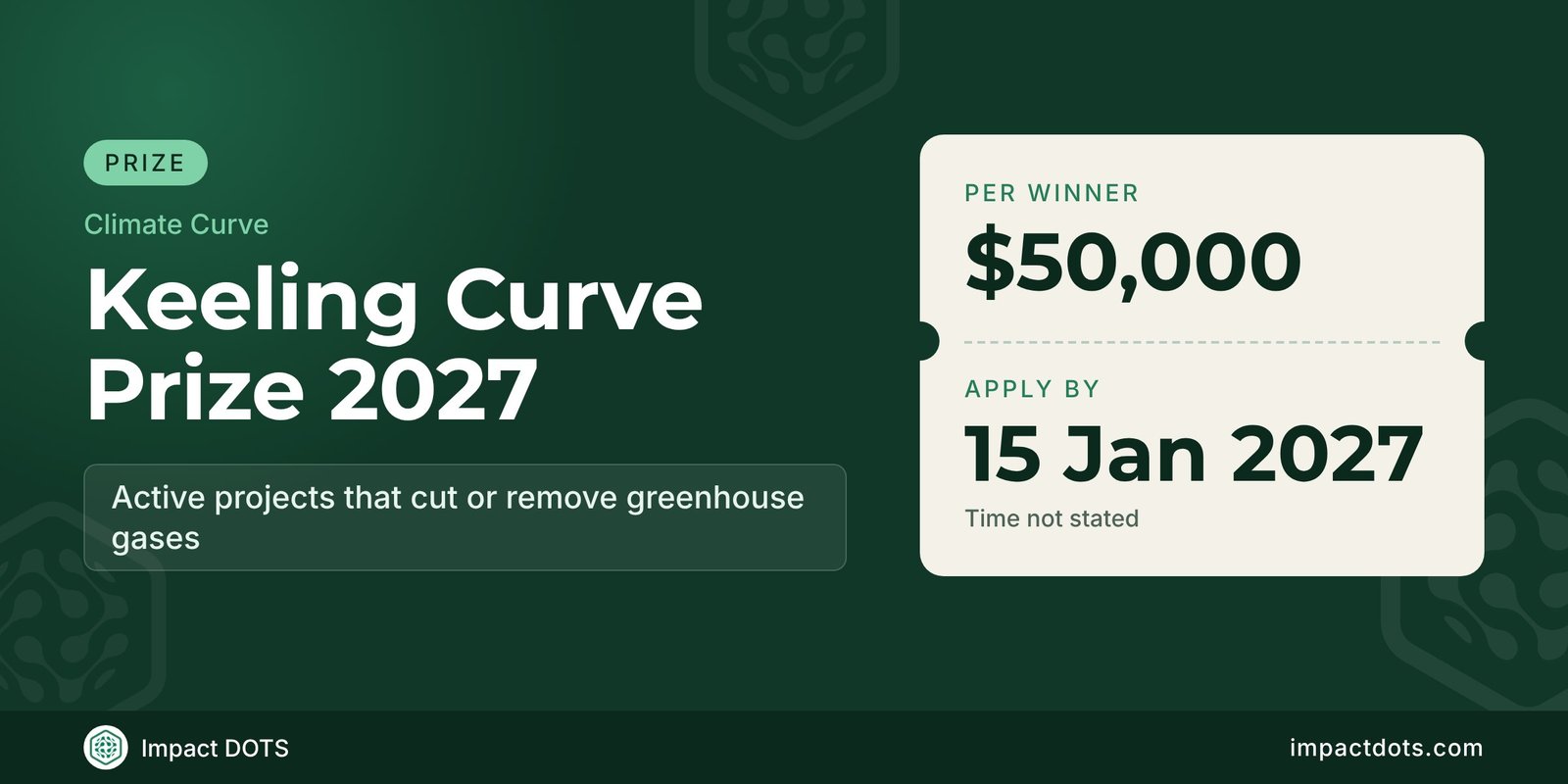
Climate Curve runs the Keeling Curve Prize, which awards $50,000 each to ten climate projects that reduce or remove greenhouse gases. Applications for the 2027 cycle opened on 1 November 2026 and close on 15 January 2027. The prize is for projects already running and producing results, not for ideas, and applications must be in English.
At a glance
| Deadline | 15 January 2027. No closing time or time zone is stated on the official pages |
| Organizer | Climate Curve |
| Awards | 10 winners, $50,000 each |
| Who can apply | Active projects or programmes from anywhere Climate Curve can send funds, subject to US sanctions rules |
| Language | English only |
| Cost to apply | No fee is mentioned on the official pages |
| Official links | Application, prize page and eligibility requirements |
What is the Keeling Curve Prize?
The prize is named after the Keeling Curve, the record of atmospheric carbon dioxide measured since 1958. Its aim is to help bend that curve down by funding projects that reduce, replace or remove greenhouse gases. Climate Curve says its applicants come from more than 109 countries, and that winners are selected by its team of climate experts.
Each applicant chooses one primary category and may list secondary ones. A project can win in only one category per year. The five categories are:
- Carbon Sinks
- Energy
- Finance
- Social & Cultural Pathways
- Transport & Mobility
Who can apply?
Climate Curve’s FAQ lists entrepreneurs and startups, university research groups, non-profits, community leaders, and intrapreneurs inside large companies or organisations. The conditions that matter most:
- The project must be active and already producing results. Past work, unimplemented ideas and untested hypotheses are not accepted.
- The application must show potential for scalable greenhouse gas reductions, and try to quantify them.
- Applicants must comply with US sanctions rules (OFAC). The official pages name Cuba, Iran, North Korea and the Crimea, Donetsk and Luhansk regions of Ukraine among the sanctioned places, with targeted sanctions on others, and advise checking the OFAC website.
- Applications are accepted in English only. An optional video in another language is accepted with English subtitles.
What you get
- $50,000 for each of the ten winners.
- Exposure, promotion and access to Climate Curve’s supporting network, as described in its FAQ.
The official pages do not say whether the award is restricted to particular uses.
How to apply
- Read the eligibility requirements and the FAQ.
- Choose your primary category and gather evidence of the emissions your project reduces or removes, and how it can scale.
- Submit in English through the official application by 15 January 2027.
Applying gives Climate Curve permission to share project information with investors, supporters and its network. Keep confidential or proprietary details out of the application. Climate Curve offers a secure channel for those.
Key dates
- Applications: 1 November 2026 to 15 January 2027
- Twenty finalists announced: spring 2027
- Ten winners announced: July 2027
Our advice
- Lead with measured results. The prize funds projects that already work, so show emissions figures and how you calculated them.
- Pick the primary category where your evidence is strongest, since you can only win in one.
- Explain scale in two ways: how the method can grow, and how it will be paid for.
- Submit well before 15 January. No closing time is given on the official pages.
FAQ
No. The prize is for current projects and programmes that are already producing results.
Climate Curve’s official pages do not mention any fee.
Yes, if your project is still active or you submit a project that fits better. Past winners may apply with a different project that uses different methods.
Twenty finalists are announced in spring 2027 and ten winners in July 2027.