
What if your well-intentioned program is actually missing the mark on creating real, lasting change? Many social initiatives launch with passion but struggle to demonstrate tangible impact.
A powerful tool exists to bridge this gap. It provides a clear roadmap from your current activities to your ultimate goals.
This strategic model, often called a results chain or logic model, outlines how specific actions contribute to a sequence of outcomes. It shows the path from your initial resources to the long-term difference you seek to make.
For managers, this clarity is invaluable. It ensures every team effort and dollar spent directly supports your mission. You can pinpoint assumptions, measure progress effectively, and adapt your strategy based on evidence.
This guide is designed for professionals who want to move beyond guesswork. We’ll break down how to build a robust framework for any social intervention.
Key Takeaways
- A theory of change is a visual roadmap that connects your activities to your desired long-term impact.
- It helps ensure all program work is aligned with the organization’s core mission and community needs.
- This model clarifies the cause-and-effect relationships between resources, actions, and results.
- Other common names for this tool include logic model, program theory, and impact pathway.
- Using this approach grounds your initiative in evidence and increases its chances of success.
- It is essential for planning, managing, and communicating the value of complex social programs.
- A well-defined theory of change allows for better measurement and adaptation over time.
Understanding the Fundamentals of a Theory of Change
Dr. Donald Kirkpatrick’s research in the 1950s laid groundwork for later, more expansive planning methods. His Kirkpatrick Model evaluated training effectiveness, focusing on measurable results.
Origins and Historical Context
The field advanced significantly in 1995. The Aspen Institute published “New Approaches to Evaluating Comprehensive Community Initiatives.” This addressed limits of older logical frameworks.
Carol Weiss, a key contributor, popularized the term “theory of change.” She described it as the necessary steps to reach a goal. This provided a clearer cause-and-effect roadmap.
Global institutions adopted the approach. The United Nations, World Bank, and USAID now use these frameworks. They guide strategic planning and evaluation for complex programs.
Core Definitions and Components
A robust program theory moves beyond simple activity lists. It explains the underlying logic of why an intervention should work. This strategic model connects resources, actions, and outcomes.
The core components create a visual pathway from inputs to long-term impact. They include assumptions, indicators, and the sequence of expected results. This structure turns abstract goals into an actionable plan for development.
Understanding these fundamentals is crucial for any social initiative. It grounds your work in evidence and historical practice.
Benefits and Applications for Social Impact Programs
Social impact work tackles complex issues like poverty, education gaps, and environmental sustainability. The goal is to improve community life and promote lasting solutions.
A well-defined theory change provides the essential framework for this work. It guides the design, execution, and review of any social program.
This roadmap ensures all efforts lead toward the desired outcomes. It turns hopeful activities into a sequence of expected results.
By mapping the journey from initial actions to final impact, teams can measure their success with clarity. They see what is working and where adjustments are needed.
Effective planning helps leaders identify every necessary step. It also reveals potential roadblocks before they derail progress.
This structured approach is vital for organizations. It brings strategic clarity and aligns every team member with the mission. The model creates a shared vision for creating positive change.
How to Develop and Revise Your Theory of Change
The development of a program’s roadmap is a collaborative effort that starts with gathering diverse insights. A sound strategic model draws on previous research, stakeholder mental models, and observed program patterns.
Inclusive Process and Evidence Review
Developing theory change requires an inclusive process. Engage managers, staff, partners, and the people your program aims to serve. Their perspectives ensure the model reflects real-world needs.
Conduct a thorough situation analysis first. Assess the specific problems your intervention must address. This step grounds your work in clear objectives.
Next, review existing documentation and relevant research. Similar projects offer valuable evidence. This data ensures your developing theory is built on a solid foundation, not just assumptions.
Iterative Refinement Practices
Your strategic theory is not a static document. Adopt iterative refinement practices to update it as you learn. New context and activity effectiveness should inform revisions.
If your strategic theory is not being used, talk with your team. Identify if perceived inadequacies are the issue. Regular evaluation keeps the model alive and actionable for driving change.
Mapping Inputs, Activities, and Desired Outcomes
Every successful program begins with a detailed map that connects its foundational resources to its ultimate goals. This map clarifies how your work leads to real community benefits.
Inputs are the dedicated resources you invest. These include funding, staff time, expertise, and materials. They provide the essential fuel for your initiative.
Activities are the specific actions your team takes. Workshops, training sessions, and service delivery are common examples. These actions consume inputs to produce direct results.
The direct, tangible products from your activities are called outputs. These could be trained individuals, distributed materials, or completed services. Outputs are your immediate deliverables.
Outcomes are the benefits or changes that follow. For instance, an output of a transit pass program leads to an outcome of reduced personal car use. This is a measurable shift in behavior.
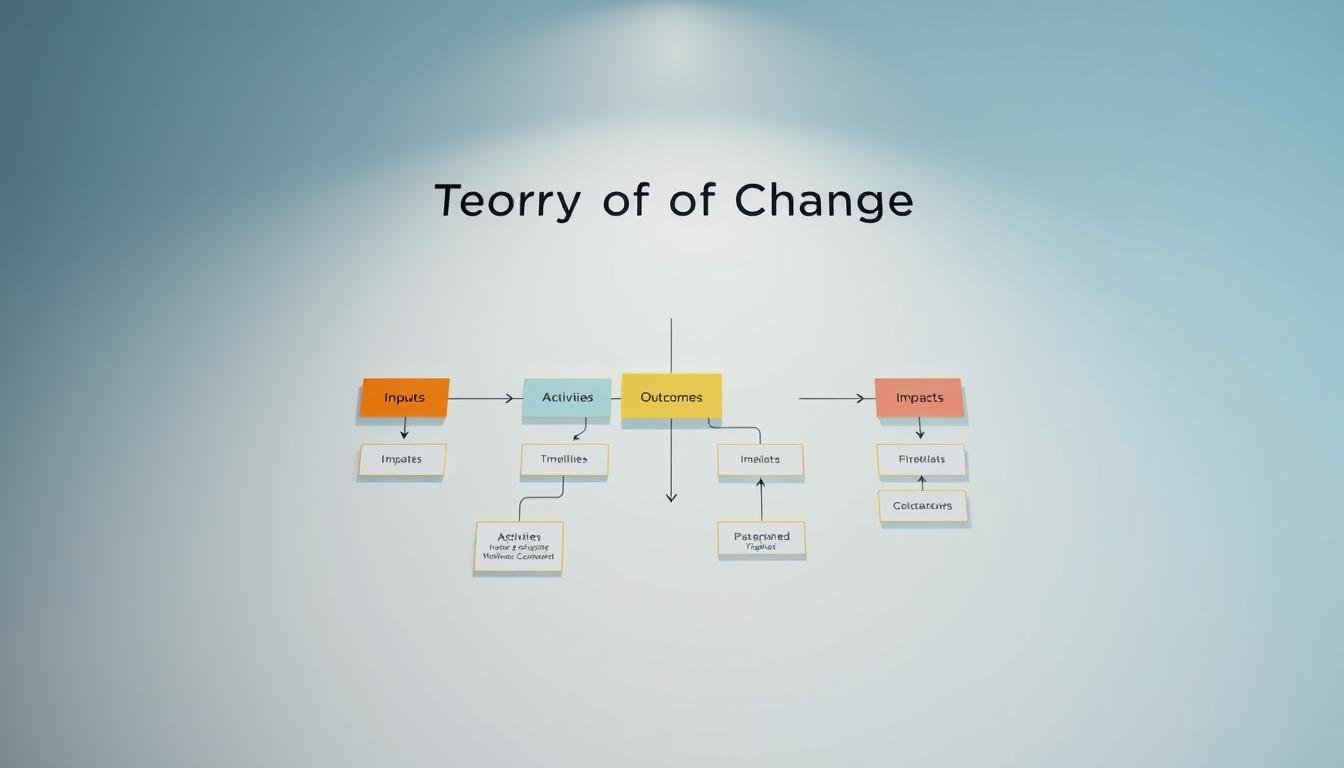
Mapping these elements creates a powerful visual chain. It shows how your invested inputs, through planned activities, generate outputs that drive your desired outcomes. This clarity ensures every resource directly supports your mission for lasting change.
Visualizing Your Theory of Change
Visual tools like logic models bridge the gap between planning and execution. They illustrate causal pathways, turning abstract strategies into clear, actionable maps.
Diagrammatic Representations and Logic Models
A logic model diagram serves as a visual map. It shows how specific actions lead to intended long-term results. This clarity is vital for team alignment.
The ESSENCE group identified key principles in 2014. Their work focused on strengthening research capacity. Collaborative models were central to their approach in many countries.
Tools like Lucidspark’s virtual whiteboard aid this process. Teams can brainstorm ideas, assess risks, and create timelines. Visualizing a program’s logic model becomes interactive and engaging.
A clear diagram helps stakeholders see the sequence of events. Potential gaps in the causal chain become obvious. This visual format guides action and improves communication among all partners.
Creating Effective Evaluation and Monitoring Strategies
The true power of a program’s roadmap is unlocked through consistent and insightful measurement. Monitoring and evaluation help identify areas that might need fine-tuning during the program lifecycle.
Effective monitoring evaluation strategies allow organizations to track progress. They assess whether a program is on the right path to reaching its goals.
By comparing actual results with expected outcomes, teams learn what works. This enables timely adjustments to their strategies for better impact.
A theory change provides the framework for identifying key indicators. It prioritizes additional data collection to fill gaps in available information.
Managers should use this strategic model to formulate precise evaluation questions. These questions focus on the critical links in the causal chain.
Continuous monitoring of progress helps identify outliers. These can be bright spots that inform learning or serious problems needing immediate attention.
Deep Dive: theory of change explained in Detail
At the heart of every effective social program lies a network of unspoken beliefs about how change happens. These assumptions form the critical foundation for your entire plan. They are your team’s shared understanding of the context and how your work functions within it.
Change mechanisms are the core theories that explain the “why.” They describe the process through which your activities are expected to produce specific outcomes. Understanding these mechanisms turns a simple action list into a powerful causal argument.
Identifying your underlying assumptions is vital. Each one represents a potential point where your intervention could fail. The path to impact is rarely straight. It is a complex web of interconnected events and reactions.
By explicitly naming these beliefs, you can assess their associated risks. This allows your organization to develop smart mitigation strategies. Your overall program logic becomes more resilient and adaptable to real-world data and results.
Stakeholder Engagement and Collaborative Development
Genuine progress in community initiatives depends on bringing together the voices of those who implement, fund, and benefit from the work. This collaborative development of a theory change ensures your plan is practical and inclusive.
Leveraging Diverse Perspectives
Involving staff, funders, and community members reveals hidden assumptions. Diverse partners can identify potential roadblocks early.
This inclusive method strengthens the program’s logic. It makes sure all organizations align their efforts toward common goals. Different viewpoints enrich the planning phase and improve decisions.
Communication and Consensus Building
Clear communication helps stakeholders understand the rationale behind key decisions. It transforms individual views into a shared vision for impact.
Articulating a unified theory change bridges different perspectives. It builds consensus among all people involved in complex social initiatives. Effective dialogue ensures everyone pulls in the same direction.
Conclusion
Achieving lasting change demands more than passion; it requires a structured approach. A robust theory change serves as your dynamic roadmap, guiding every step from initial resources to long-term impact.
Integrating solid evidence with diverse stakeholder views ensures your strategies stay effective. Continuous refinement based on real data keeps your program agile and responsive.
Visual tools like the logic model clarify complex causal pathways. This makes it easier for all partners to align their activities and track progress toward shared outcomes.
Explicitly naming your assumptions and risks turns potential obstacles into chances for learning and adaptation. This proactive stance strengthens your entire planning and evaluation process.
Ultimately, this strategic model empowers organizations to move beyond counting activities. It focuses efforts on delivering meaningful, sustainable results and success for the communities they serve.